
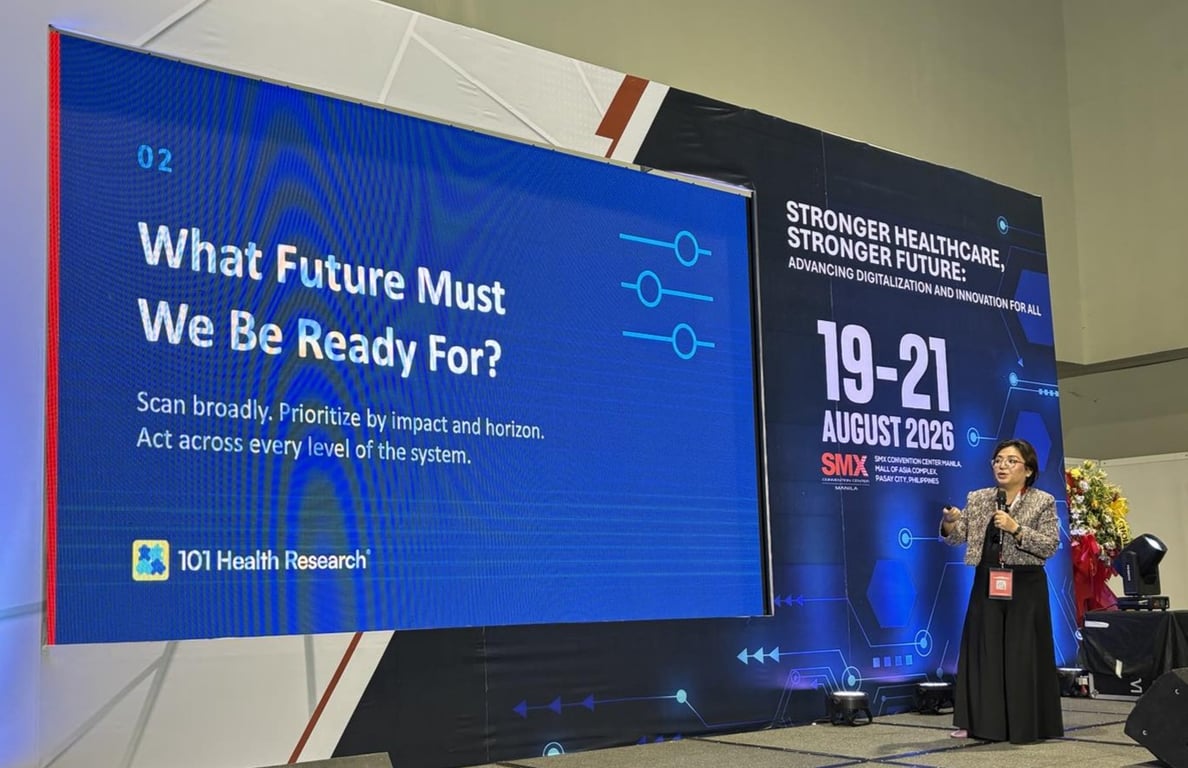
At the Philippine Medical Expo 2026, healthcare innovation was examined as part of a wider system of people, institutions, data, financing, and trust.
The Philippine Medical Expo 2026 brought together healthcare professionals, hospital leaders, technology providers, pharmaceutical companies, distributors, entrepreneurs, investors, innovators, and students at the SMX Convention Center Manila from August 19 to 21.
The event showcased medical technology, hospital and laboratory equipment, pharmaceutical solutions, digital health platforms, healthcare artificial intelligence, and software. Beyond the technologies on display, however, was a larger question: How can innovation create meaningful and equitable value within the health system?
This question shaped the lecture “Healthcare 360: Connecting Care, Talent, and Learning for a Smarter, Future-Ready Health System,” delivered by Dr. Venus Oliva Cloma-Rosales, Founder and Managing Director of 101 Health Research, through the invitation of the University of the Philippines Manila Technology Transfer and Business Development Office.
Healthcare is a system
Drawing from systems thinker Donella Meadows, the lecture described a system as a set of elements, interconnections, and a purpose. Its outcomes are shaped not only by its individual components, but also by the relationships, information flows, rules, incentives, and feedback connecting them.
This perspective is essential in healthcare. A new medical device, digital platform, diagnostic tool, or artificial intelligence model does not operate independently. It enters an environment of patients, health workers, facilities, workflows, financing arrangements, regulations, data systems, and institutional cultures.
“A technically excellent AI tool will not improve health if clinicians do not trust it, data are unreliable, workflows cannot support it, patients cannot access the next stage of care, or no one can finance what follows,” Cloma-Rosales said.
The World Health Organization identifies six interconnected health-system building blocks: leadership and governance, service delivery, health financing, the health workforce, medical products and technologies, and health information systems.
Systems thinking emphasizes that these components cannot be strengthened in isolation. Introducing a technology may alter workforce roles, service workflows, data requirements, financing needs, and governance responsibilities.
Situating innovation within the system
The lecture used the micro–meso–macro lens of Health Policy and Systems Research.
At the micro level are patients, families, communities, and frontline health workers – the people who experience care, make clinical decisions, and build or lose trust.
At the meso level are hospitals, primary-care facilities, universities, research institutions, professional networks, and healthcare businesses. These organizations translate policies, resources, and technologies into actual services.
At the macro level are health policies, financing systems, regulation, markets, digital infrastructure, political conditions, and the wider social and environmental context.
An innovation may be safe and effective in a controlled setting, yet fail in practice if patients and health workers do not accept it, organizations cannot integrate it, or financing and regulation do not support it.
Situating innovation within the system therefore requires asking: What problem does it address? Who will use it, and who may be excluded? Does it fit existing workflows and institutional capacities? Are the necessary data, infrastructure, financing, and governance mechanisms available? Can it be maintained, evaluated, improved, and scaled responsibly?
Three drivers reshaping healthcare
The lecture identified three major forces influencing health systems and healthcare innovation: artificial intelligence, climate change, and the policies and politics of Universal Health Care.
AI and digital transformation can expand diagnostic, administrative, and clinical capabilities. However, they may also amplify bias, fragment information systems, and widen inequities when access, infrastructure, or digital literacy are uneven.
Climate change affects disease patterns as well as the resilience of healthcare facilities, supply chains, health workers, transportation networks, and digital infrastructure. A facility may remain physically intact during a disaster but lose functional capacity if workers cannot safely reach it or essential supplies cannot be delivered.
Universal Health Care policies and politics shape who receives care, how services are financed, which technologies are adopted, and whether reforms can be sustained. Expanding access requires not only policy commitments, but also financing, institutional capacity, governance, public trust, and political support.
These forces interact. AI may support climate surveillance and UHC planning, but it may also create new costs or inequalities. Climate disruption can undermine service delivery and health financing. UHC reforms may create demand for new technologies while requiring stronger regulation and accountability.
Building a Learning Health System
The lecture introduced the Learning Health System, one that continuously converts care and experience into trusted data, data into knowledge, and knowledge into better care.
Digital tools and AI can accelerate this cycle, but technology cannot independently determine what matters, what is equitable, or what action should follow. Human judgment remains essential for contextual interpretation, accountability, ethical decision-making, and trust.
Examples from 101 Health Research’s nursing workforce study and the mid-term evaluation of the National Unified Health Research Agenda 2023-2028 illustrated this point.
Follow 101 Health Research on Instagram and Facebook (@101healthresearch) for more updates, research findings, and insights on health systems and evidence-based healthcare.
The nursing study showed that digitalization may improve nursing work and create new career pathways, but may also increase workload when training, infrastructure, workflow design, and institutional support are inadequate. It also demonstrated that climate resilience is closely linked to workforce resilience.
The NUHRA evaluation showed that setting research priorities is only the beginning. A future-ready research system also requires skilled people, capable institutions, connected data, appropriate financing, efficient processes, and pathways that translate research into policy, practice, innovation, and community benefit.
A future-ready health system is not necessarily the one with the most advanced technology. It is the one that learns, adapts responsibly, protects its people, and ensures that innovation creates equitable public value.