
The Adoption Gap Behind Low Productivity
More than half of the Philippines’ rainfed rice lands are in Mindanao, yet the slow uptake of available climate-smart technologies remains one of the main constraints on farmer productivity and resilience in the region. In October 2026, the Department of Agriculture-Bureau of Agricultural Research and the International Rice Research Institute brought local agricultural partners from Zamboanga Peninsula, Northern Mindanao, and Agusan del Sur together to address that gap through the Enhancing Frameworks for Fast and Effective Cascading of Technologies in Agriculture, or EFFECT, project.
EFFECT is not a technology-demonstration project in the conventional sense. It is a scaling project: its purpose is to identify which innovations farmers already prefer, map the institutional pathways that allow those innovations to reach them, and validate crop suitability maps that reflect actual growing conditions rather than national averages.
Crop Suitability Maps Built With Farmers, Not for Them
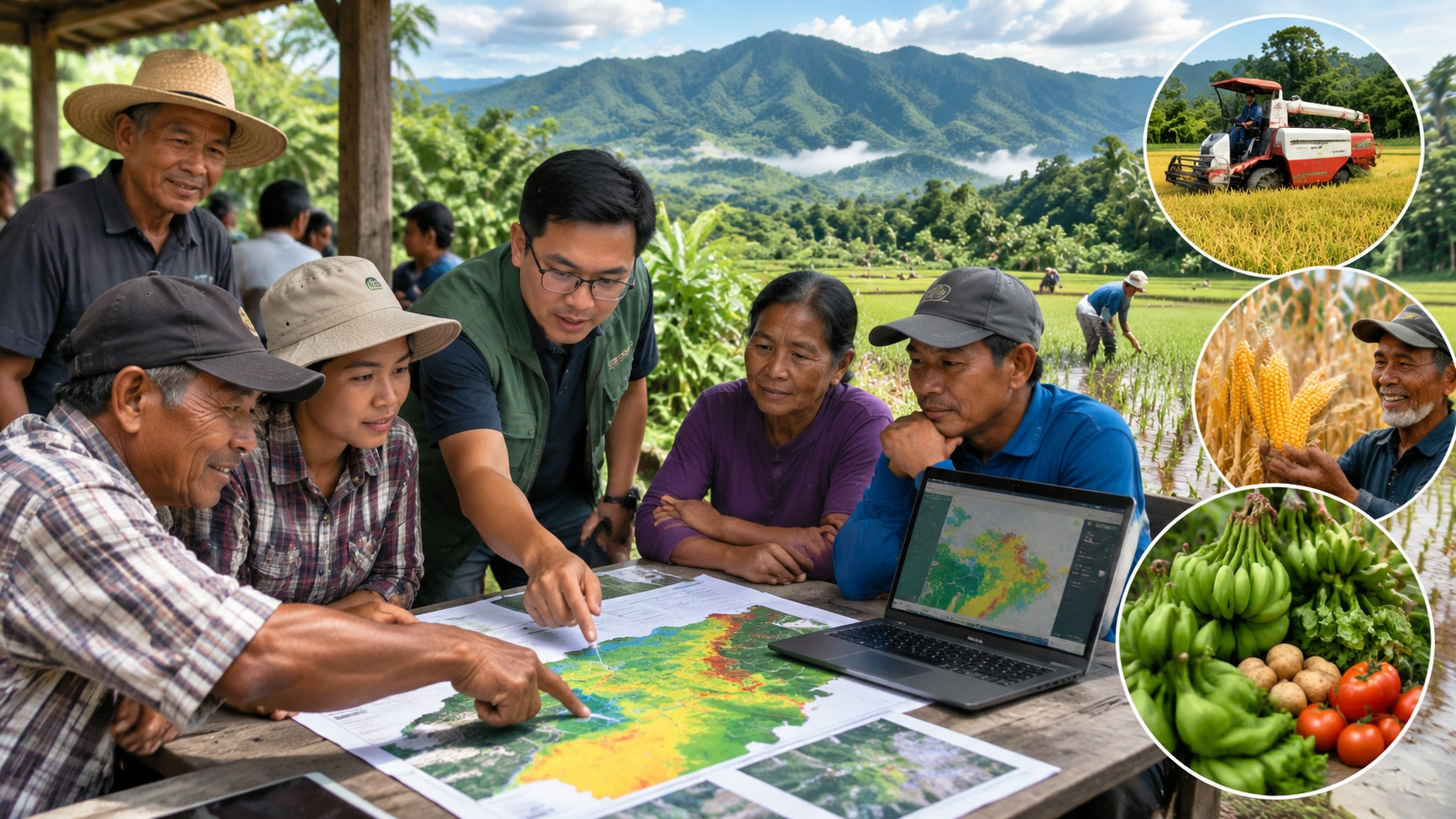
The project’s participatory mapping process combines spatial data on climate, soil, and terrain with farmers’ and local implementers’ knowledge of seasonal cropping calendars. Regional groups identified priority crops and cropping sequences—rice-rice, rice-corn, corn-corn, and patterns involving banana, potato, vegetables, and sugarcane—and marked local cropping patterns on base maps for digitization.
That approach matters because rainfed agriculture is highly location-specific. A variety or planting window that performs in one municipality can fail in a neighboring valley with different soil moisture and rainfall distribution. By validating preliminary suitability maps with local knowledge, EFFECT is building a targeting tool that can guide which technologies go where, rather than distributing the same package across heterogeneous landscapes.
Scaling Pathways That Already Exist
The project’s stakeholder mapping surfaced existing local arrangements that can carry innovations to scale. In Zamboanga Peninsula, corn clusters already connect farmers with input suppliers, financing, hauling services, and buyers; packaging relevant innovations into these business relationships could benefit both farmers and private sector partners. In Northern Mindanao, local government-funded seed and fertilizer subsidies, mechanization, and agricultural support services provide a foundation that can be leveraged for wider technology adoption.
Strengthening farmer associations as service providers emerged as another pathway, supported by technical, business, and financial management training. Participants also emphasized machinery service fees that cover operations, maintenance, and eventual replacement—a practical financing model that keeps equipment functional beyond the initial grant.
From Northern Luzon to Mindanao: A Sequencing Logic
EFFECT’s expansion follows earlier engagements in Ilocos Region, Cagayan Valley, and Eastern Visayas, and supports DA-BAR’s SCALE UP program by integrating crop suitability mapping, innovation profiling, and locally informed scaling approaches into implementation. The sequencing reflects a recognition that technology transfer fails when it is treated as a one-time distribution event rather than a system of financing, service delivery, and infrastructure that sustains adoption over multiple seasons.
The project’s contribution is less a new variety or machine than a method for deciding which interventions fit which places—and which institutional arrangements can keep them in use after the pilot ends. In rainfed Mindanao, where climate risk is high and margins are thin, that method may prove as valuable as the technologies it carries.