
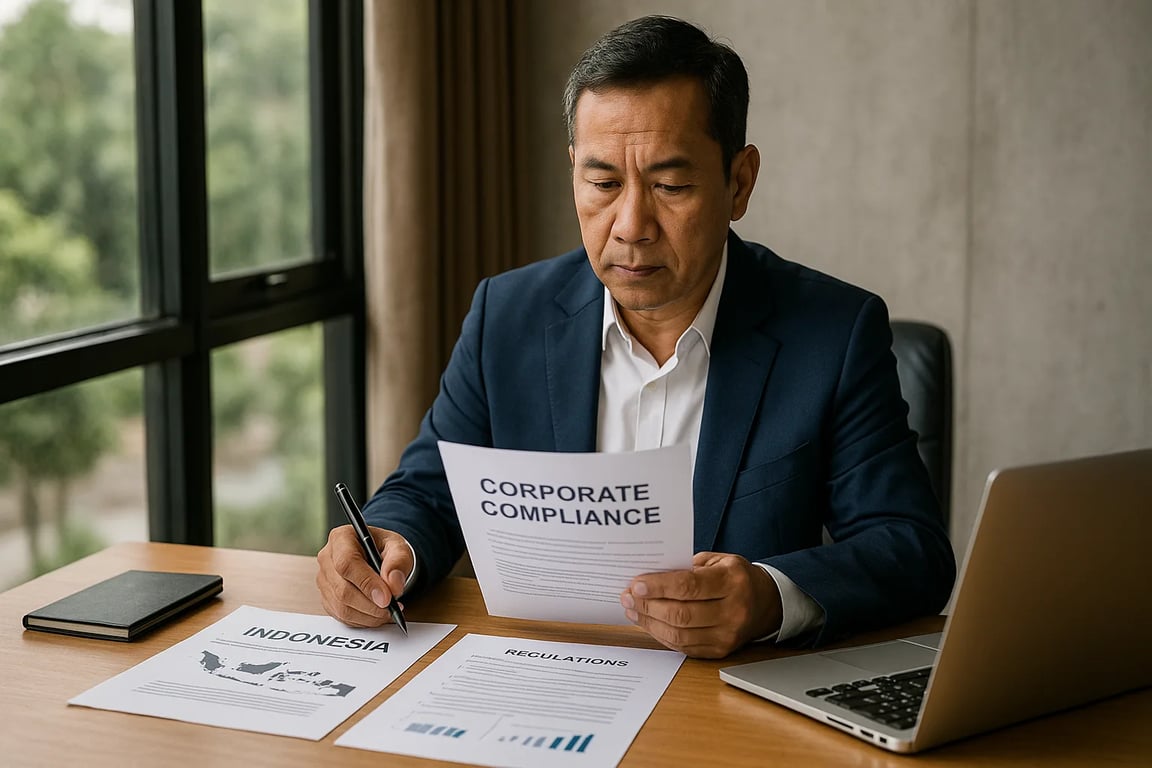
For foreign investors operating in Indonesia, appointing a resident director is often treated as a procedural requirement tied to company formation. In practice, it is one of the most consequential governance decisions a business can make. Indonesian company law places substantial responsibility on directors, and in certain circumstances, that responsibility can extend to personal civil or criminal liability.
As regulatory enforcement becomes more coordinated—particularly across tax, manpower, and licensing authorities—the role of the resident director has moved firmly into the spotlight. For foreign owners, understanding where corporate responsibility ends and personal exposure begins is no longer optional.
Indonesia follows the principle of limited liability, but its Company Law (Law No. 40 of 2007) gives directors a high level of accountability. Directors are expected to manage the company actively, in good faith, and in compliance with all applicable laws. When these duties are breached, regulators, creditors, or even shareholders may pursue the director personally.
This framework matters especially for foreign-owned companies (PT PMA), where a resident director is typically required to ensure daily operability. Banking, tax reporting, licensing, immigration coordination, and government correspondence often require a director who is physically present and legally authorized to act in Indonesia.
That authority brings convenience—but also risk. A resident director is not merely a signatory; they are legally responsible for how the company is run.
Indonesian law imposes several non-negotiable obligations on directors. Among the most significant are the duties to act in good faith, manage the company in its best interests, comply with laws and internal regulations, and implement shareholder resolutions.
Directors must also ensure that corporate records and financial statements are accurate and properly maintained. Failure to do so can be interpreted as negligence, particularly if it leads to financial loss or regulatory breaches.
In companies with multiple directors, liability may be joint and several. This means one director can be held responsible for the actions—or inaction—of another if governance controls are weak or oversight is lacking.
While day-to-day business decisions are generally protected, Indonesian law allows personal liability in specific situations.
Civil liability may arise where losses are caused by mismanagement, negligence, unauthorized contracts, or violations of the articles of association. In more severe cases, courts may look beyond the corporate entity if they find abuse of structure, bad faith, or reckless conduct.
Criminal liability is also possible. Directors may be investigated individually for serious tax violations, labor and foreign manpower breaches, operating without required permits, environmental damage, or misuse of company funds. Criminal responsibility cannot be waived or insured against, regardless of shareholder agreements.
These risks are not theoretical. Enforcement actions increasingly target individuals, not just companies, particularly where non-compliance is systemic or prolonged.
Several recurring issues account for the majority of director exposure in Indonesia.
Insolvency is one of the most sensitive. Continuing operations when a company is technically insolvent—without informing shareholders or taking corrective action—may be interpreted as reckless trading.
Tax compliance is another frequent trigger. Monthly filings, withholding taxes, VAT, and annual returns must be accurate and timely. Delegating tax work does not remove director responsibility.
Foreign manpower compliance is equally critical. Errors involving RPTKA approvals, work permits, or unauthorized foreign workers can result in sanctions directed at the director, not just the employer.
Finally, exceeding authority—such as signing contracts outside approved limits—can expose directors to claims if losses follow.
Indonesian law does recognize protections for directors who act responsibly. Decisions made in good faith, with reasonable care and proper information, are generally protected under principles similar to the business judgment rule.
Documentation is central to this protection. Directors should ensure that key decisions are recorded, shareholder resolutions are implemented properly, and delegations of authority are clearly defined.
Many foreign-owned companies also adopt Directors & Officers (D&O) insurance to cover civil claims related to management decisions. While it does not protect against criminal prosecution, it can mitigate financial exposure in disputes.
Clear director service agreements and indemnity clauses also help define responsibilities and allocate internal risk, even though they cannot override statutory liability.
The increasing focus on resident director liability reflects a broader regulatory shift in Indonesia toward accountability through identifiable decision-makers. For foreign investors, this elevates governance from an administrative concern to a strategic one.
Advisors experienced in Indonesian corporate governance, such as CPT Corporate, are frequently consulted on company registration and board structuring to help foreign owners align director roles with legal and operational realities, rather than relying on informal or nominee arrangements.
The takeaway for investors is clear: a resident director should be selected for competence and involvement, not convenience.
In Indonesia, the resident director is a gatekeeper of compliance, not a symbolic appointment. The role carries authority, responsibility, and potential exposure that can directly affect both the individual and the company.
Foreign owners who understand this early—and put proper governance, documentation, and safeguards in place—are far better positioned to operate confidently in Indonesia’s evolving regulatory environment. Those who underestimate it may find that corporate liability does not always stop at the company’s door.
In 2025, effective market entry and sustainable operations in Indonesia increasingly depend on one principle: accountability begins with the board.
This press release has also been published on VRITIMES