
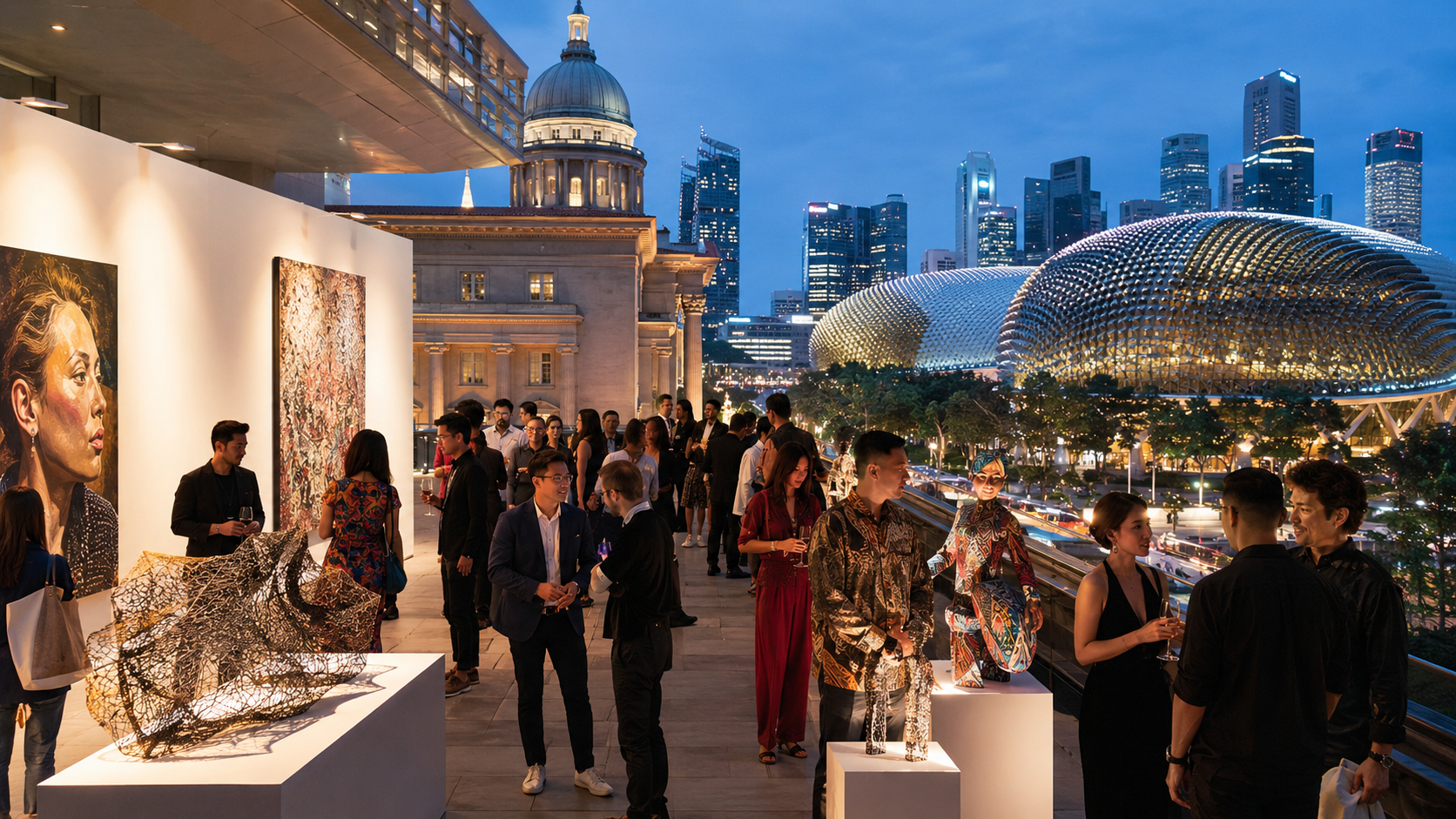
Why Singapore Is Emerging as Southeast Asia’s Cultural Gateway for Contemporary Art and Creative Business
Singapore’s influence in the arts comes from a familiar national strength: its ability to connect different parts of the world.
Just as the country developed into a centre for international finance and trade, it has positioned itself as a meeting place for artists, galleries, collectors and cultural institutions. Its location, transport links, multilingual population and strong infrastructure give it advantages that few regional cities can match.
Yet infrastructure alone does not create an art hub. Singapore’s cultural rise has also required institutions, policy, investment and a sustained effort to make Southeast Asian creativity more visible.
A Network of Institutions Supports the Scene
National Gallery Singapore has become one of the city’s most influential cultural landmarks. Its focus on Singaporean and Southeast Asian modern art helps audiences understand the region through its own histories, political experiences and aesthetic movements.
The Singapore Art Museum plays a complementary role by engaging with contemporary practices.
Beyond visual art, Esplanade – Theatres on the Bay provides a major platform for music, dance and theatre. Its presence demonstrates how Singapore treats culture as a broad ecosystem rather than a collection of isolated industries.
Gillman Barracks has also helped create a physical meeting point for galleries and arts organisations. Although commercial art districts constantly change as galleries respond to costs and market conditions, the site remains relevant to discussions about Singapore’s creative infrastructure.
Cultural Policy Gives the Sector a Long-Term Framework
Singapore differs from many art markets because public policy is deeply involved in cultural development.
The National Arts Council supports artists, organisations and audience-building initiatives. The Our SG Arts Plan 2023–2027 provides a current multi-year framework for strengthening participation and the wider arts ecosystem.
The council publishes official information about its programmes and priorities at https://www.nac.gov.sg/.
This sustained public involvement can provide artists and organisations with greater continuity. However, it also produces a debate that accompanies many state-supported cultural systems: how can the sector preserve independence and creative risk?
The strongest arts ecosystems are rarely comfortable. They allow artists to question institutions, social expectations and established narratives. Singapore’s long-term cultural reputation will depend partly on its ability to maintain that creative tension.
ART SG Connects Culture With the Global Market
The development of ART SG has increased Singapore’s visibility among international galleries and collectors.
Its significance is amplified by Singapore Art Week, which brings together exhibitions, programmes and events across the city. The combination allows visitors to experience different levels of the ecosystem, from large commercial presentations to museums and smaller creative initiatives.
This is where Singapore’s role as a gateway becomes most visible.
A collector interested in Southeast Asia can use the city as a starting point for discovering artists from multiple countries. An artist or gallery from the region can potentially meet audiences who would otherwise be difficult to reach.
Beyond the Idea of an “Art Market”
Singapore’s cultural future should not be judged solely through auction results or the number of wealthy collectors attending a fair.
A genuine creative centre also needs affordable spaces, adventurous programming, strong arts education and opportunities for independent practitioners.
Singapore already has the institutions and global networks required for regional influence. Its deeper challenge is to ensure that the people who make art can continue to experiment inside an increasingly expensive and professionally structured city.
The answer will shape whether Singapore remains primarily a successful destination for showing and selling art or develops into an even more influential place for creating the ideas that define Southeast Asia’s cultural future.