
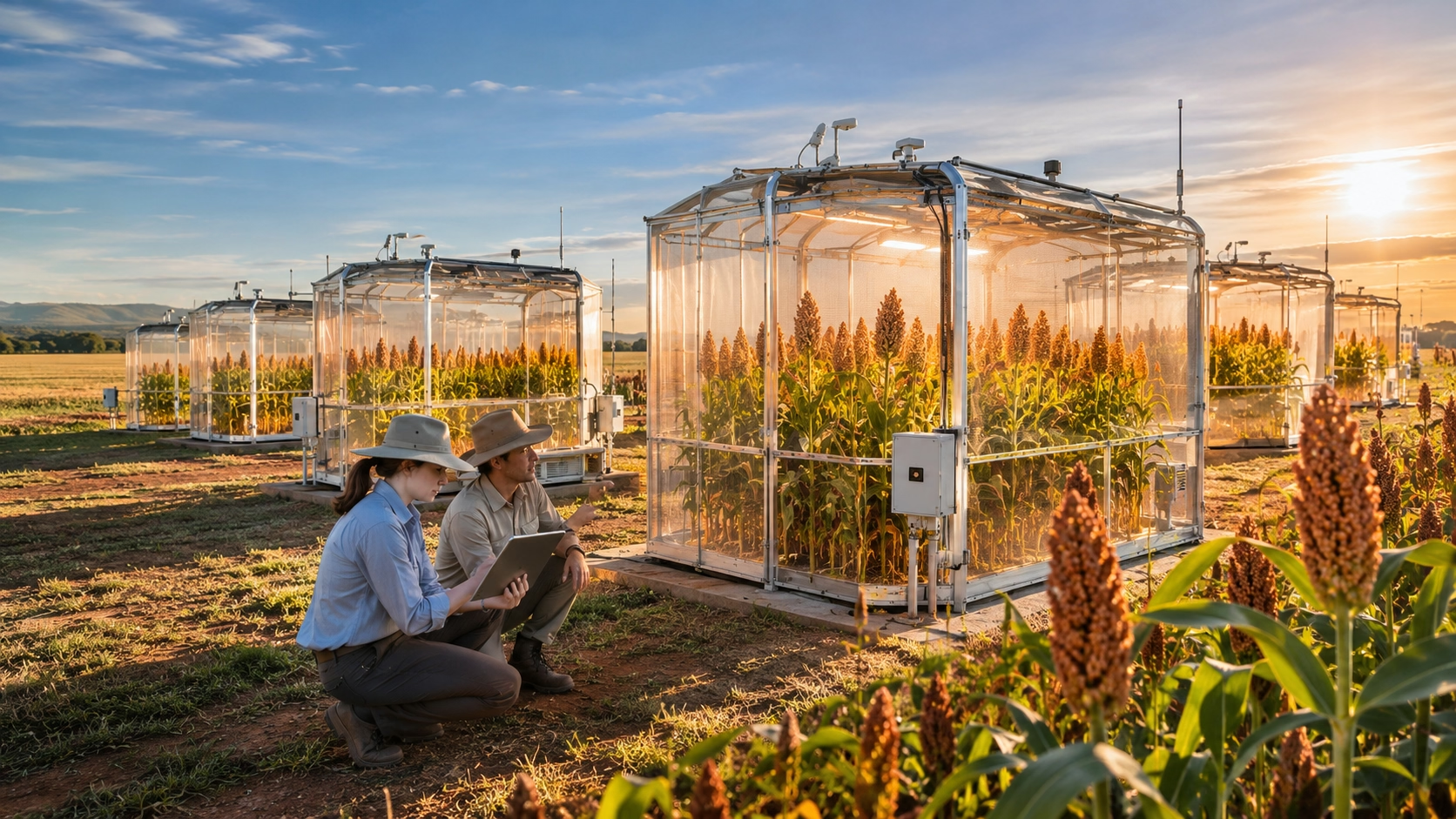
The Experiment That Puts Crops Inside a Climate Change Simulator
At the Central Queensland Smart Cropping Centre in Emerald, six purpose-built chambers now stand in the paddock, each capable of raising internal night-time temperatures by up to three degrees Celsius . Commissioned in August 2026 and designed in partnership with global technology company Biora, these are the largest structures of their kind in the world, built specifically for Queensland conditions . Their target is sorghum — a grain used for stockfeed and food products ranging from beer to gluten-free flour — and the question they are designed to answer is blunt: what happens to yield and quality when the night no longer cools down?
Why Night-Time Heat Matters More Than Daytime Peaks
Most climate research focuses on daytime heat spikes. But plant physiology tells a different story. Overnight temperatures govern respiration, grain filling, and stress recovery. When nights stay hot, crops burn through energy they would otherwise store, and yield penalties compound. The Emerald chambers allow researchers to isolate that variable in a real field environment, not a glasshouse. Equipped with remote monitoring devices, the chambers gather continuous data on heat stress impacts, enabling the identification of practical management strategies that reduce production risk .
The Policy Backdrop: $30 Billion by 2030
The research is one of more than 230 actions under Primary Industries Prosper 2050, the Queensland Government’s long-term blueprint for the sector . Minister for Primary Industries Tony Perrett framed the investment explicitly around productivity and food security: “By leveraging advanced technologies like in-field heat chambers, we are equipping Queensland farmers with the knowledge to better understand and manage the impacts of an increasingly variable climate” . The government’s stated target is to lift the value of primary production output to $30 billion by 2030 .
The Real-World Stake: Sorghum as a Test Case
Sorghum is not a niche crop. It is a rotational workhorse in northern farming systems, tolerant of heat and drought but not invincible. If night-time temperatures continue to rise, sorghum’s role in supplying feedlots, food manufacturers, and export markets comes under pressure. The Emerald trials are designed to produce management options that growers can use now — not theoretical models for 2050. The chambers are in the paddock, the sensors are running, and the data is being collected in the conditions farmers actually face.